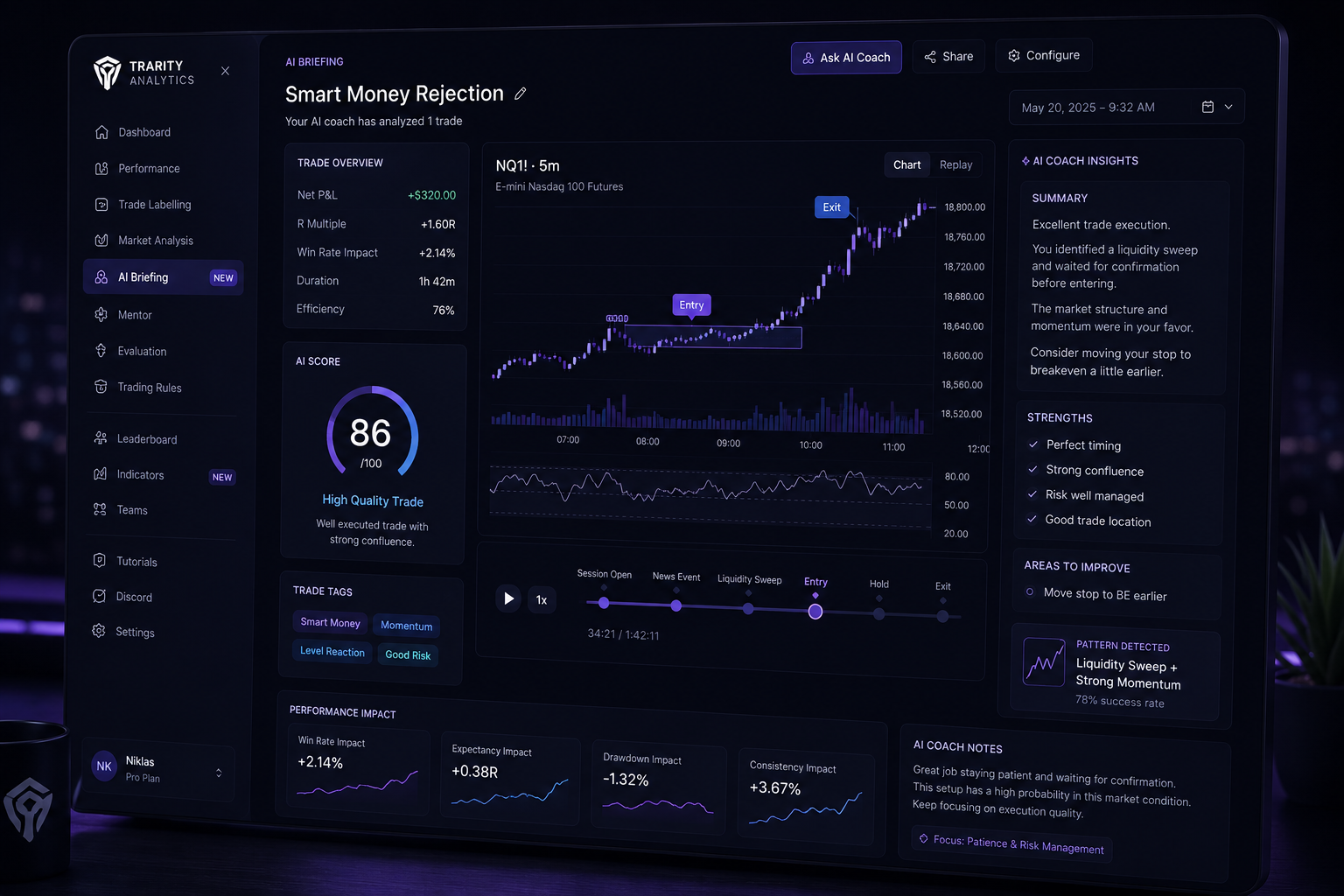
An AI trading coach should never replace your trading decisions, but it can improve your trade review process dramatically. Think of it as a review assistant that helps you analyse what happened after the session, not an auto-trader that tells you what to click.
What Is an AI Trading Coach?
An AI trading coach reads your journaled activity and turns raw logs into useful coaching signals. It reviews entries, exits, notes, outcomes, and context, then surfaces patterns, recurring trading mistakes, and behaviour trends that are easy to miss manually.
In practice, an AI trade coach works from your own data — not from market prediction. It acts like an analyst for your trading journal app, producing feedback you can use to refine process and risk habits over time.
What AI Can and Cannot Do
Clear expectations matter. AI trade review is powerful when used for analysis and accountability, but it has hard limits.
- AI can: spot patterns in large datasets, highlight repeating mistakes, summarise behaviour trends, save time on manual reviews.
- AI cannot: predict the market, replace trading skill, make decisions for you, or produce quality insights from poor data.
Use AI as a second pair of eyes. Keep final execution decisions with the trader.
How AI Reviews Your Trading Behaviour
A good AI trading assistant follows a simple workflow: ingest your trade logs, parse notes, classify trade labels, and evaluate outcomes by context. It then compares behaviour across sessions to find where execution quality shifts.
This is where AI trading analytics becomes practical. It can flag anomalies such as overtrading after a loss, repeated stop-loss violations, or impulsive entries after missed moves — and convert them into clear performance insights.
Finding Repeating Mistakes Faster
Without AI, you might spend hours scanning hundreds of rows and still miss critical clusters. An AI trading assistant can surface these patterns in seconds.
You might discover that Friday trades underperform, or that revenge entries account for 40% of total losses. That speed is the practical edge of AI trade review: less manual work, faster learning loops, fewer repeated mistakes.
When you consistently use trade labels, AI can analyse results by setup type and execution context. Instead of vague impressions, you get objective comparisons.
Your "breakout" tag may show a 62% win rate, while your "counter-trend" tag remains net negative. This turns labels into actionable feedback you can apply in your next session.
Using AI to Improve Discipline
Trading discipline often weakens gradually before your P&L reflects it. AI can track whether you follow rules, respect sizing limits, and execute according to plan across different market conditions.
By monitoring consistency, an AI trading coach helps you catch behaviour drift early — making it easier to correct process before small rule breaks become expensive habits.
Why AI Works Best With Good Data
Garbage in, garbage out. If your logs are incomplete or inconsistent, AI output will be noisy. Use a structured journal that captures entries, exits, notes, emotions, and labels for trustworthy coaching insights.
A dedicated trading journal app makes this easier by standardising how you log each position and keeping data ready for deeper analysis.
How Trarity Uses AI in the Review Workflow
Trarity combines workflow automation with AI coaching so reviews stay fast, structured, and useful after every session:
- Personalised session-by-session feedback through the AI coaching feature.
- Pattern detection across hundreds of trades using integrated trading analytics.
- Mistake tracking that highlights recurring execution and risk errors.
- Actionable suggestions to improve consistency and decision quality.
Get AI-powered trade reviews
Let Trarity's AI coach surface the patterns you're missing, spot mistakes faster, and accelerate your learning loop. Full access for 30 days — no card required.
Start for free arrow_forwardFrequently Asked Questions
An AI trading coach analyzes your trade journal data — entries, exits, notes, labels, and outcomes — and gives feedback on patterns, mistakes, and behaviour. It doesn't predict the market; it helps you learn from your own history.
No. AI is best at pattern recognition and data analysis at scale. A human mentor provides context, experience, and emotional support. But AI handles the data-heavy side of trade review far more efficiently.
AI can provide some insights with as few as 20–30 trades, but feedback becomes more accurate as your dataset grows. Consistency in logging is more important than volume.
At minimum, trade entries, exits, and outcomes. For deeper insights, it benefits from notes, emotional ratings, trade labels, screenshots, and risk management data.
AI feedback is based on your own data and should be treated as a second opinion, not a directive. Always apply your own judgment. The best use is to surface blind spots and confirm patterns you suspect.
This article was created with the help of AI and reviewed and edited by the Trarity team.