A trading journal without labels is like a filing cabinet with no folders. You can store every trade, but finding patterns across hundreds of entries becomes nearly impossible. Trade labelling solves this by letting you tag each trade with context — the setup you used, the mistakes you made, and the emotions you felt.
What Is Trade Labelling?
Trade labeling is the practice of attaching structured tags to every trade so you can sort and analyze performance by category. Think of labels as columns in a dataset: each tag has a defined meaning, and each trade can be grouped with others that share that label.
This is different from ordinary notes. Notes are free-form text and hard to aggregate. You cannot filter 400 trades by a phrase you typed in frustration. With labels, you can. A modern trading journal app handles this naturally: assign tags once, then filter and compare instantly.
Most traders already have opinions about their performance. "I think Fridays are weaker." "I probably overtrade after a loss." The problem is that intuition can be wrong. Trade tags turn impressions into evidence.
When every trade includes labels, you can isolate one category and inspect hard outcomes: win rate, profit factor, average loss, expectancy. Instead of guessing which behaviors hurt your account, you point to numbers.
Setup tags identify what pattern or strategy generated each trade. Common examples: breakout, pullback, range reversal, trend continuation, opening range, news fade.
Most traders find that one or two setup labels generate most of total profit, while several others contribute almost nothing. Without setup tags, weak patterns hide inside aggregate P&L.
Keep setup categories focused. A practical target is 5 to 8 setup labels total. Too few and analysis becomes vague; too many and you create overlap that weakens conclusions.
Mistake tags capture where you deviated from plan. Examples: entry too early, entry too late, closed too early, held too long, moved stop, sizing error, traded outside playbook.
Most performance leaks are repetitive, not random. One recurring execution error can erase the gains from an otherwise valid strategy. Tagging exposes that leak in plain numbers.
Psychology tags capture the mental state that influenced execution: revenge trading, FOMO, overtrading, hesitation, confidence, discipline. These are uncomfortable because they force honesty, but often the most valuable layer in your dataset.
Psychology tags interact strongly with mistake tags. Revenge trading frequently co-occurs with sizing errors, while FOMO aligns with chased entries. An AI trading coach can highlight these cross-patterns automatically.
Risk tags track whether each trade respected your predefined risk framework: correct sizing, oversized, no stop, stop too tight, stop too wide, risk-reward below minimum.
Without risk tags, a bad result is ambiguous. Did the setup fail, or did you size too large? Risk labels answer these questions and prevent you from abandoning a good setup for the wrong reason.
Entry and Exit Tags
For entries: on plan, early entry, late entry, chased entry. For exits: hit target, trailed stop, closed early, held too long. This split gives two clean lenses on execution.
Many traders misdiagnose where edge is lost. You might have strong selection but weak exits, or average entries but strong management. Separate tags isolate the failure point.
Market regime tags label the environment: trending, ranging, volatile, choppy, low-volatility. The same setup can behave very differently across regimes. Regime labels let you measure this directly.
How to Avoid Tag Overload
Start with 3–4 categories: setup, mistake, psychology, and risk. Within each, keep only 5–8 options. Your labels should feel obvious at a glance, not debatable for five minutes.
If a tag appears in fewer than 5% of trades over a month, merge or remove it. Review your full label list monthly.
How Trarity Turns Labels into Analytics
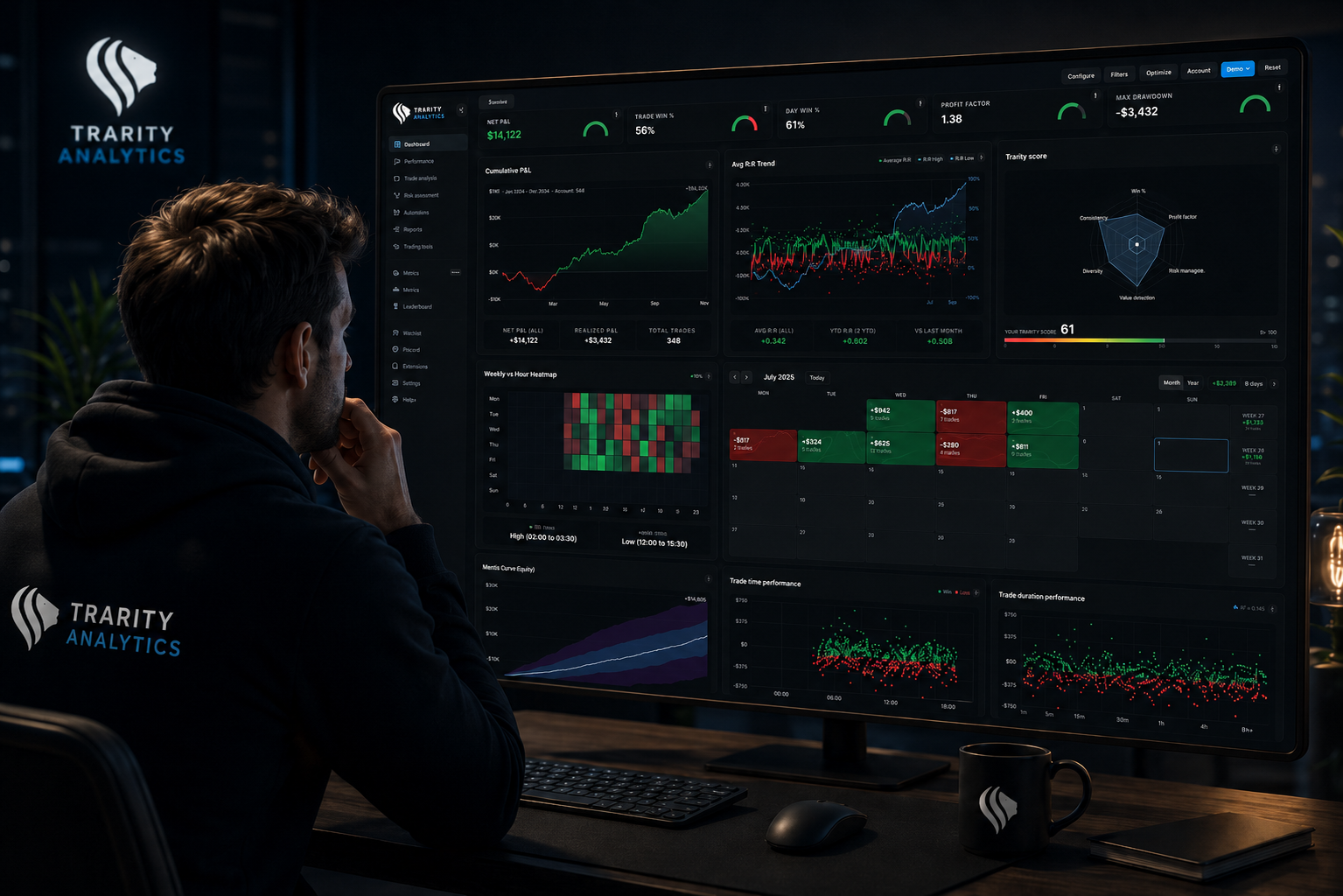
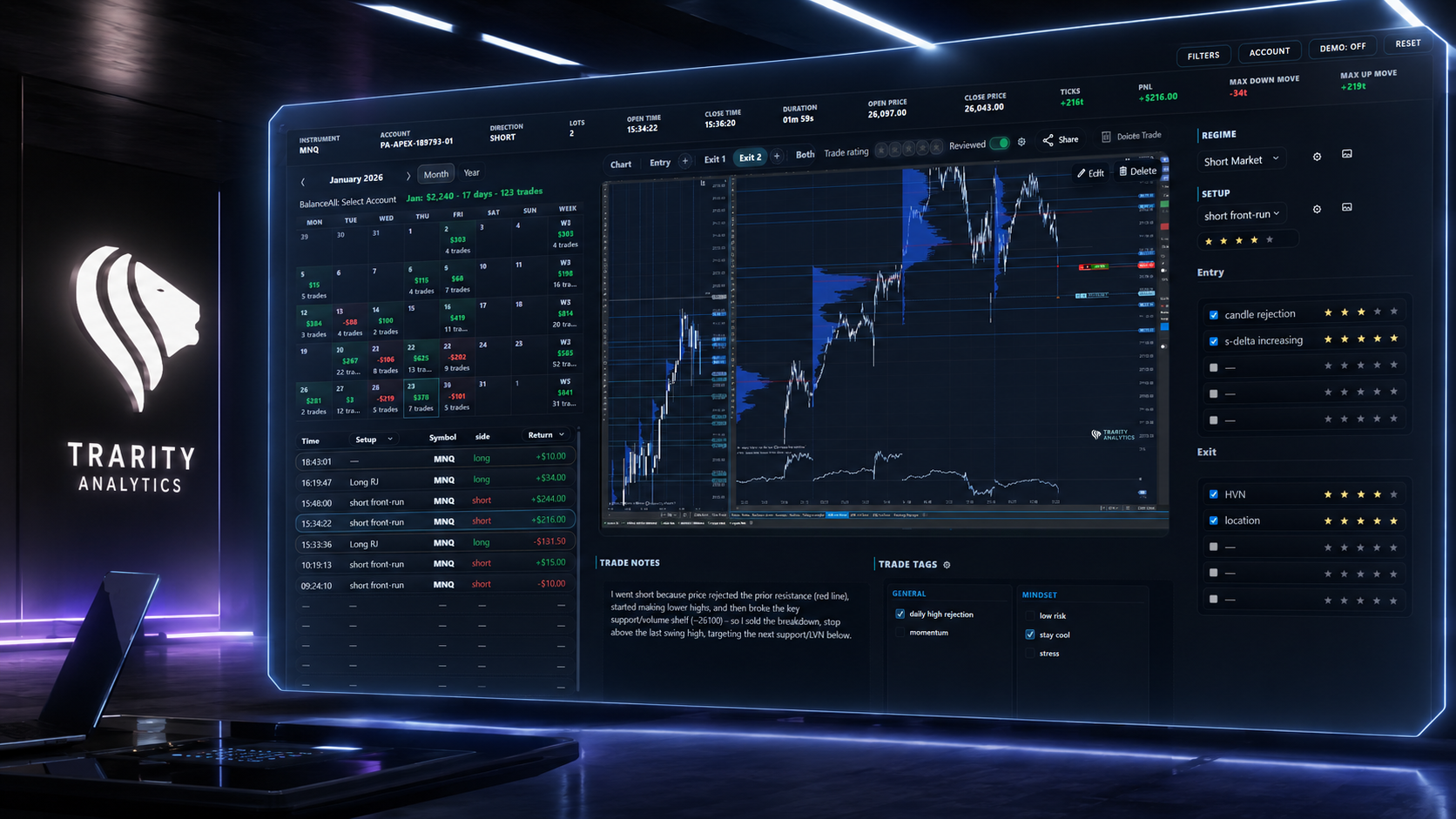
In Trarity, labeling categories are built in: regime, tags, setup, and entry/exit conditions. These are first-class analytics dimensions connected directly to performance metrics — filter win rate, expectancy, drawdown, and execution quality by any label combination.
Trarity also makes correlation analysis practical: surface where psychology tags and mistake tags overlap, identify recurring risk failures by setup, and track whether corrective actions reduce error frequency over time.
Start tagging your trades with Trarity
Label setups, track mistakes, and find the patterns that cost you money. Full access for 30 days — no card required.
Start for free arrow_forwardFrequently Asked Questions
Start with one tag from each category — setup, mistake (if any), and psychology. Three to four labels per trade is enough to generate useful analytics without slowing down your journaling.
Trade labels are structured, filterable categories you can aggregate across many trades. Notes are free-form text for context. Labels power your analytics.
Yes. Tagging trades with a revenge trading label lets you filter for those trades and see their win rate, average loss, and frequency. Making the pattern visible is the first step to breaking it.
Market regime tags classify trades by environment — trending, ranging, volatile, choppy, or low-volatility. They help measure how the same setup performs across different contexts.
At minimum, tag every trade with a setup label. Mistake and psychology tags only apply when relevant — not every trade involves a mistake or emotional deviation.
Review your tag list once a month. Remove tags you never use, merge tags that overlap, and add new ones only if you notice a recurring pattern that existing tags do not capture.
This article was created with the help of AI and reviewed and edited by the Trarity team.