Most traders spend months refining setups but execute them at inconsistent hours. Time-of-day is one of the cleanest filters available because it is observable, repeatable, and measurable. If your strategy has edge, that edge usually appears stronger in specific session windows.
Timing Is a Free Edge
Many avoid timing analysis because it feels "too simple" compared with indicator tuning. But execution quality changes dramatically with liquidity, spread, and volatility. The same entry logic can behave very differently at 08:30 UTC versus 14:30 UTC.
Unlike discretionary pattern interpretation, time-of-day can be filtered mechanically. That makes it a reliable lever for reducing random trades and improving consistency without changing your core strategy model.
When you identify your best and worst hours, you gain immediate operational clarity: trade more where your edge is proven and trade less where expectancy is weak.
The Four Major Trading Sessions
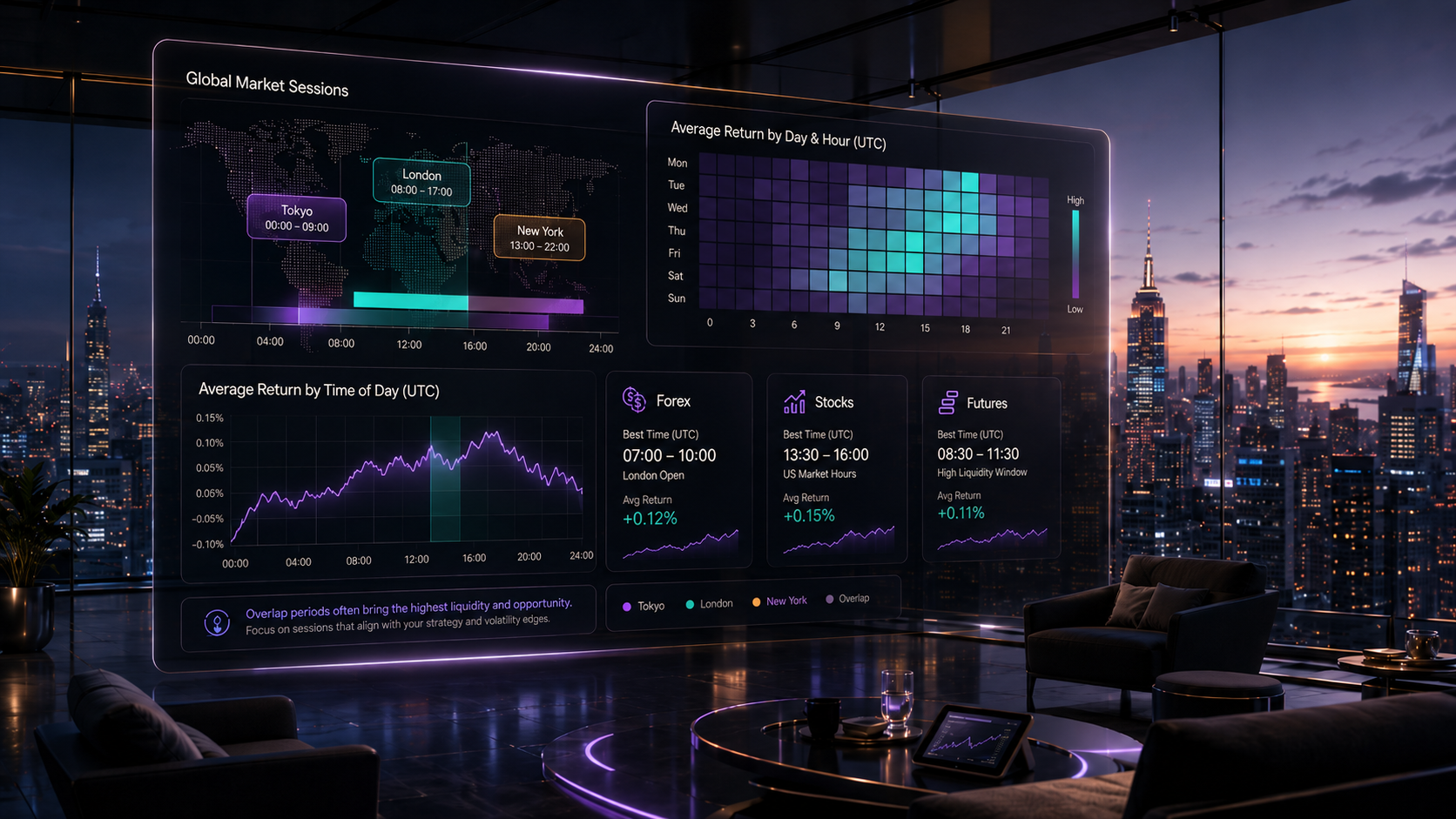
Global markets rotate through four primary sessions: Sydney (around 21:00-06:00 UTC), Tokyo (00:00-09:00 UTC), London (07:00-16:00 UTC), and New York (13:00-22:00 UTC). Exact behavior shifts seasonally, but these windows define the daily structure most traders experience.
Session character differs. Sydney is often quieter and thinner. Tokyo is orderly but can accelerate around JPY flows. London typically introduces directional moves and broader participation. New York adds macro catalysts and major institutional volume.
The overlap windows are especially important. London-New York overlap often produces the highest forex liquidity and cleaner momentum for major pairs. Aligning your strategy with overlap behavior can materially improve fill quality and follow-through.
Best Time to Trade Forex
For major USD pairs, the London/New York overlap (roughly 13:00-17:00 UTC) is frequently the most efficient window. Spreads are tighter, volume is deeper, and directional continuation is more likely after key levels break.
JPY pairs can exhibit better movement in the Asian session when regional flows dominate. EUR and GBP crosses often become most active as London opens. The point is not universal timing; it is pair-specific behavior verified by data.
Track average pip range by hour for the pairs you actually trade. This helps calibrate realistic stop/target distances and prevents forcing trades in low-range hours where expected movement cannot justify execution risk.
Best Time to Trade Stocks
US equities typically concentrate opportunity in three blocks: the first 90 minutes after open, the midday slowdown, and the final power hour. The open offers fast repricing and opening-range setups, but also the highest noise and slippage risk.
The lunch session often compresses volatility and increases mean-reversion chop, which can punish momentum entries. Many discretionary traders improve consistency simply by avoiding this period unless a specific catalyst is active.
The final hour restores institutional participation and often provides cleaner trend continuation or reversal structures. After-hours trading can look attractive, but thinner books and wider spreads increase execution risk, especially for retail-sized stop orders.
Best Time to Trade Futures
Index futures like ES and NQ trade nearly 24 hours, but behavior differs between Globex and regular trading hours (RTH). Globex can offer smoother overnight structure, while RTH often produces larger impulse moves around cash open and US data releases.
Crude oil futures frequently react around inventory reports, where volatility expands sharply and spread behavior changes. Gold often responds to London flow transitions and macro headlines, making session context critical to trade planning.
If your futures strategy underperforms, check whether you are trading the right setup in the wrong session regime. Session mismatch is a common source of avoidable drawdown.
Find YOUR Best Hours Using Data
General session rules are useful, but your own dataset should drive your final trading window. A practical workflow is: import trades, group results by hour, and compare win rate, expectancy, and average drawdown per slot.
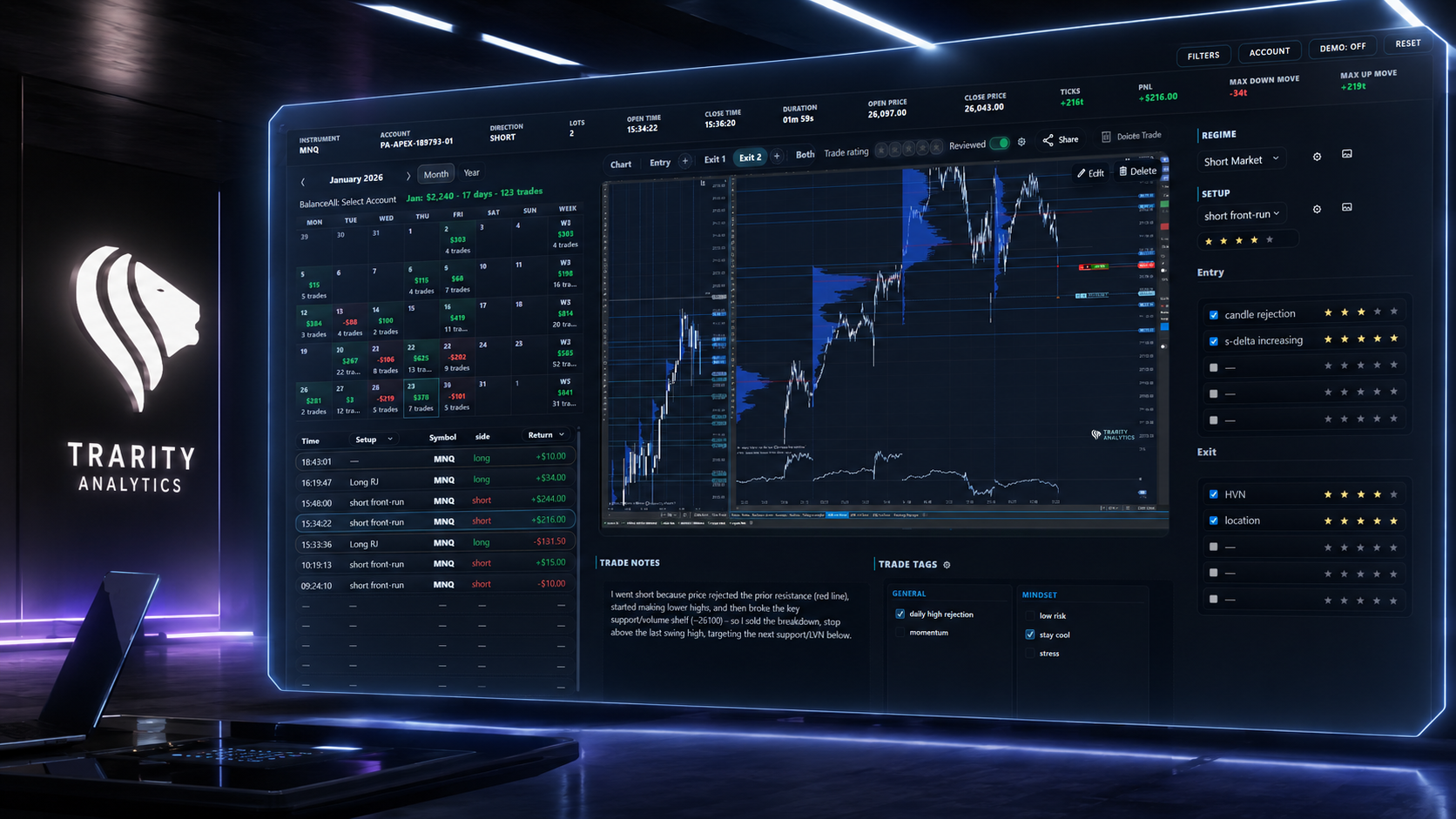
In Trarity, the time-of-day heatmap helps you quickly identify green and red windows. Green hours usually combine positive expectancy with stable variance. Red hours often reveal overtrading, low liquidity execution, or emotional decisions after missed setups.
Once the pattern is clear, convert it into an explicit rule in your routine: trade only in your top windows, size down in neutral windows, and avoid consistently negative windows unless conditions have changed and you are re-testing deliberately.
Common Mistakes
Small sample bias: drawing conclusions from 6 trades in a time slot is noise, not insight. Ignoring news context: event-driven spikes can distort hourly averages if not labeled separately. Correlation confusion: good outcomes in one window may come from one setup, not the clock alone.
Overfitting: narrowing your window too aggressively can destroy opportunity and leave you with untradeable rules. No revalidation: session behavior evolves with macro regimes, so timing filters need periodic review.
The fix is disciplined measurement: enough trades per slot, setup-level segmentation, and monthly validation. Timing edge should make your execution simpler, not more fragile.
Find your most profitable hours
Trarity's time-of-day heatmap shows exactly when you trade best — and worst. Free for 30 days.
Start for free arrow_forwardFrequently Asked Questions
It depends on market and instrument, but volatility often peaks near major opens and overlap windows. Forex majors are frequently most active during London-New York overlap, while US equities often move most at the open and final hour.
If your system is not built for event risk, reducing size or waiting for post-news structure is usually prudent. News windows can widen spreads and increase slippage.
A practical minimum is about 20 trades per slot, with stronger confidence above 40 to 50. Keep setup and instrument context consistent when comparing.
Yes. Daylight-saving shifts, holiday liquidity, earnings cycles, and macro regimes can all alter session behavior. Revalidate timing filters regularly.
Yes. With time-of-day analytics, you can build rules that prioritize profitable windows and avoid weak ones, turning timing into a repeatable process decision.
This article was created with the help of AI and reviewed and edited by the Trarity team.